Thawing, repairs & prevention
Frozen & Burst Pipe Repair in Lancaster, PA
You turn on the kitchen tap on a single-digit morning and get a trickle, or nothing. Here’s how to thaw a frozen pipe safely, what to do if it’s already split, and how Lancaster homeowners keep it from happening again.
Why Pipes Freeze and Burst
Frozen pipe repair in Lancaster means safely thawing a supply line that froze in a cold wall, crawl space or garage, then repairing any section that split. Pipes usually burst because ice blocks the line and pressure builds between the ice and a closed faucet, not because the ice itself cracks the pipe.
That’s also why a burst often isn’t noticed until later. The pipe can split overnight while frozen solid, then start pouring once the sun or the furnace warms that wall up. If you find a frozen pipe, treat it as a pipe that might already be cracked. Have someone stand by the main shutoff while you thaw it, and you’ll catch a leak in seconds instead of minutes. It’s one of the busiest winter jobs for any Lancaster PA plumber.
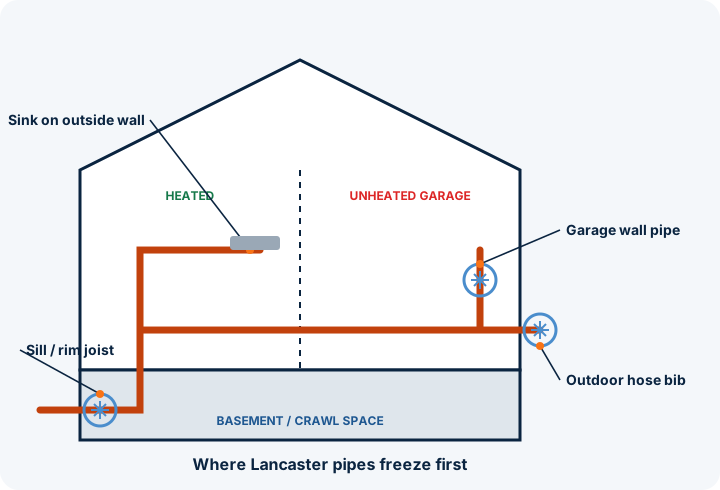
Where Pipes Freeze in Lancaster Homes
- Kitchen sinks on outside walls, common in rowhomes where the kitchen sits in a rear addition with thin, poorly insulated walls.
- The basement sill and rim joist, where cold air leaks in around the top of the foundation and chills pipes running along it.
- Crawl spaces under additions, porches and sunrooms, especially in county farmhouses with older additions.
- Unheated garages and rooms above garages.
- Outdoor hose bibs left connected to a hose, or not shut off from inside for winter.
- Laundry rooms and half baths added onto the back of the house.
Stone farmhouses with thick masonry walls hold heat well inside the original house, but the plumbing in their additions doesn’t share that advantage. Newer homes have better insulation but more plumbing in exterior walls and over garages.
How to Thaw a Frozen Pipe Safely
- Open the faucet the pipe feeds, both hot and cold sides, so melting water has somewhere to go and pressure can escape.
- Find the frozen section. It’s often the coldest exposed part, sometimes with visible frost.
- Apply gentle heat starting from the faucet side and working back: a hair dryer, a heat lamp, towels soaked in hot water, or a space heater kept a safe distance away.
- Open cabinet doors and raise the thermostat to warm the whole area.
- Keep heating until full pressure returns, then check carefully along the pipe for drips or spraying.
Propane torches, kerosene heaters and charcoal grills cause house fires and carbon monoxide poisoning every winter. Old wood framing next to a pipe can catch fire behind the wall where you can’t see it. If you can’t reach the frozen section, call a plumber.
If a Pipe Has Already Burst
Act in this order:
- Close the main water shutoff right away.
- Open the lowest faucet in the house to drain remaining water from the lines.
- Turn off the water heater so it doesn’t run dry and overheat.
- Cut power to wet areas if it’s safe to reach the breaker.
- Move belongings, take photos and start removing water.
- Call a plumber, then your insurance company.
The plumber cuts out the damaged section and replaces it with new copper or PEX, then checks the rest of the line for other splits; one freeze often damages several spots. If the pipe runs through an outside wall, they may suggest rerouting it to an interior wall or adding insulation so it doesn’t happen again. Follow the emergency plumbing checklist while you wait.
Keeping Pipes From Freezing Next Winter
| Step | Why it works |
|---|---|
| Shut off and drain outdoor spigots in fall | Water left in the hose bib freezes and splits the pipe inside the wall |
| Install frost-free sillcocks | The valve sits inside the heated house, so the outside part drains itself |
| Seal and insulate the rim joist | Stops cold air from reaching pipes along the basement sill |
| Insulate pipes in crawl spaces and garages | Foam sleeves slow heat loss; heat cable helps on the worst runs |
| Keep the thermostat steady | Turning the heat way down at night lets exterior walls get dangerously cold |
| Drip the most exposed faucet on frigid nights | Moving water is harder to freeze and relieves pressure |
| Shut off water when away | Close the main and drain lines if you leave for a winter trip |
Frozen lines on the drain side happen too, mostly where a drain runs through an unheated space or where a roof vent ices over. A plumber can check both during a fall tune-up. If you’re not sure whether the cold already did damage, watch for a rising water bill or new stains, and see leak detection.
Leaving Home in Winter
Heading south for a week in February, or closing up a rental or a family farmhouse for the season? That’s when frozen pipes do the most damage, because nobody is there to notice the leak for days. Keep the thermostat at 55°F or higher, open cabinet doors under sinks on outside walls, and ask a neighbor to check the house. For longer trips, close the main shutoff and open faucets to drain the lines; if the house has hot-water heat, leave the boiler on. Many homeowners now add a smart leak detector or an automatic shutoff valve that cuts the water and sends a phone alert. Some insurance policies require that the home be heated or the water shut off while you’re away, so check yours.
Heat Cable, Insulation and Rerouting
For pipes that freeze every winter, a plumber has a few permanent fixes. Foam pipe insulation is the cheapest and works well in basements and crawl spaces. Thermostatically controlled heat cable, wrapped along a vulnerable pipe and plugged into a GFCI outlet, keeps water above freezing on the worst nights. Sealing gaps around the rim joist and crawl space vents stops the cold air that causes the freeze in the first place. And sometimes the best answer is moving the pipe: rerouting a kitchen supply line from an outside wall to an inside one, or replacing an old hose bib with a frost-free model. If a cold snap already left you with a water heater that struggles, mention that while the plumber is there.
FAQ
Frozen Pipe Questions from Lancaster Homeowners
How do I know if my pipes are frozen?
A faucet that gives only a trickle or nothing on a very cold morning, while other faucets work, is the classic sign. You may see frost on an exposed pipe or a bulge in the line.
At what temperature do pipes freeze?
Water freezes at 32°F, but pipes inside a heated home are usually at risk when outdoor temperatures drop into the low 20s or below, especially in unheated spaces or exterior walls, and faster with wind.
Should I let my faucets drip in Lancaster?
On the coldest nights, letting a thin stream run from the faucet farthest from the main or on an outside wall helps keep water moving and relieves pressure. It costs far less than a burst pipe.
Will a frozen pipe always burst?
No, many thaw without damage. But it’s smart to assume it might be cracked and watch closely as it thaws, with someone ready at the main shutoff.
Does insurance cover burst pipes?
Many homeowners policies cover sudden damage from a burst pipe, but some exclude damage if the home was left unheated. Document everything and call your insurer promptly.
What is a frost-free outdoor faucet?
A frost-free sillcock has a long stem so the actual valve sits inside the heated house. When you shut it off, the outside section drains, so it doesn’t freeze. You still need to disconnect the hose.
Can a frozen drain pipe burst?
Drain pipes rarely burst the way pressurized supply lines do, but a drain or vent that freezes can block fixtures, cause backups and crack old cast iron or plastic fittings. It’s most common where a drain passes through an unheated space or where a roof vent ices shut. A plumber can thaw it safely and suggest insulation or rerouting.
Why did my pipes freeze when the heat was on?
The pipe was probably in an exterior wall, a crawl space or near a rim joist with air leaks, where the temperature can drop well below the room temperature, especially with wind. Sealing air leaks and insulating that run usually fixes it.
Talk to a local Lancaster plumber
Frozen or burst pipe? Get a local plumber on it.
One free call connects you with an independent plumbing company that handles winter pipe repairs across Lancaster County.
(717) 750-0501