Serving Lancaster City, Lititz, Millersville, Ephrata, Mount Joy & Lancaster County, PAFree referral call: (717) 750-0501
(717) 750-0501

Lancaster City · Lancaster County · Pennsylvania

Plumber in Lancaster, PA

No hot water this morning, a pipe that split in the cold snap, a basement drain backing up, or a drip under the sink that keeps getting worse? One free call connects you with an independent plumbing company that works in Lancaster and the towns around it, so a local plumber can find the problem and fix it.

  • Free referral call
  • Water heaters
  • Drains & sewers
  • Frozen & burst pipes

Lancaster PA Plumber is a referral service, not a plumbing company. Your call goes to an independent local plumber. How it works.

Quick answer

A plumber in Lancaster, PA handles most residential plumbing in the area, and spends most days on the same handful of jobs: water heaters that quit or leak, kitchen and basement drains that clog, old sewer laterals full of roots, pipes that freeze and split in January, and slow leaks hiding behind walls and under floors. Lancaster’s old housing, hard water and cold winters make all of them more common here than in a newer, warmer city.

Why Plumbing Breaks in Lancaster, and When to Call

Walk any block between Penn Square and the edges of the city and you’re looking at brick rowhomes, twins and Victorians that are well past their hundredth birthday. Behind those walls you’ll find every era of plumbing stacked on top of each other: galvanized steel supply lines that rust shut from the inside, cast-iron drain stacks, clay sewer pipe out to the street, and copper or PEX added during a kitchen remodel in the ’90s. Out in the county, stone farmhouses and newer developments add well pumps, water softeners and septic systems to the mix.

Then there’s the water itself. Much of Lancaster County sits on limestone, and hard water leaves scale in water heaters, faucet aerators and shower valves. Add a winter where nights regularly drop into the teens, and you get the calls local plumbers hear over and over: “the hot water’s all,” “the basement floor drain is backing up,” and “there’s water coming through the kitchen ceiling.” Call right away if water is leaking, if a drain backs up into a tub or floor drain, if you smell gas near the water heater, or if a pipe froze. Waiting is how a small repair turns into new drywall and flooring.

Plumber kneeling at an open sink cabinet working on the drain and supply pipes

Plumbing services in Lancaster

Plumbing in Lancaster, PA: What Local Plumbers Fix Every Week

These are the jobs local plumbing companies get called for most often. Each one has its own guide with what to check before the plumber arrives.

Water Heater Repair & Replacement

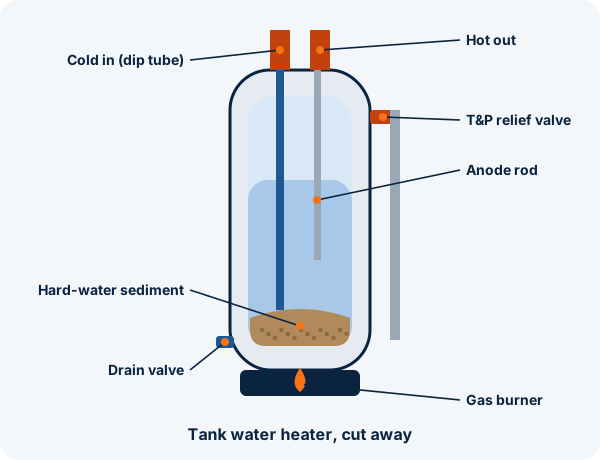
Lukewarm showers, a rumbling tank, rusty hot water or a puddle around the base all point to a water heater that’s struggling. Lancaster’s hard water speeds up sediment and scale, so tanks here often wear out sooner than the label promises. A plumber can tell you whether it needs a part, a flush or a new heater.

Water heater repair
Labeled cutaway diagram of a tank water heater showing the dip tube, anode rod, relief valve, sediment layer and burner

Emergency Plumbing

A burst pipe, a sewer backup into the basement, a water heater dumping water across the floor or a toilet overflowing at 11 p.m. Here’s what to shut off in the first five minutes, and who to call.

Emergency plumber

Drain Cleaning

Kitchen sinks full of grease, hair in the tub, basement floor drains and slow toilets, cleared with the right tool for old pipes.

Drain cleaning

Sewer Line Repair

Roots in clay pipe, cracked cast iron and sagging laterals. Camera inspection first, then repair or trenchless lining.

Sewer line repair

Frozen & Burst Pipes

Thawing safely, shutting off water fast and fixing the split pipe before it floods the basement.

Frozen pipe repair

Leak Detection & Repair

A rising water bill, a stain on the ceiling or a meter that spins with every tap closed. Finding the leak without tearing up the house.

Leak repair

Symptom checker

What Is Your Plumbing Trying to Tell You?

Pipes, drains and water heaters usually give a warning before they fail. Match what you see, hear or smell to the likely cause.

Tap everything you’ve noticed and the checker points you to the most useful guide. It’s a starting point, not a diagnosis. If water is actively leaking, find your main shutoff valve and close it first.

Plumbing symptoms at a glance

Plumbing symptoms and what they mean
What you noticeWhat it usually meansWhere to start
Hot water runs out halfway through a showerSediment in the tank or a failed dip tube or elementWater heater repair
Several drains slow at once, or the floor drain backs upA blockage in the main drain or sewer lateralSewer line repair
Just one sink or tub is slowA local clog of grease, hair or soap scumDrain cleaning
A faucet gives a trickle on a frigid morningA pipe has frozen in an outside wall or crawl spaceFrozen pipe repair
Water stain spreading on a ceilingA leaking supply line, drain or shower valve aboveLeak detection
Rotten-egg smell from the hot waterBacteria reacting with the anode rod in the tankWater heater repair

Winter in Lancaster County

How Cold Is Too Cold for Your Pipes?

The outdoor temperature is the quickest way to judge your freeze risk. Pipes in unheated spaces go first.

January in Lancaster is hard on pipes

Every winter brings a stretch when the wind comes down off the hills and the overnight low drops into the teens or single digits. That’s when local plumbers’ phones light up. Water expands as it freezes, and pressure builds in the pipe between the ice and the closed faucet until copper splits or a PEX fitting lets go. The pipe often doesn’t leak until it thaws, which is why so many burst pipes are found mid-morning, after the sun warms the wall.

The weak spots are predictable in Lancaster homes. In city rowhomes it’s the kitchen sink on an exterior wall, the back-addition laundry with thin walls, and the line running along the basement sill where cold air sneaks in at the rim joist. In county homes it’s pipes in crawl spaces, unheated garages, bonus rooms over garages and outdoor hose bibs that were never shut off for the season. Older stone farmhouses with thick walls stay warmer inside, but their additions and porches often don’t.

The fix before it happens is simple: keep the heat at the same setting day and night, open the cabinet doors under sinks on outside walls, let a thin stream run from the most exposed faucet on the coldest nights, and close the inside shutoff for each outdoor spigot in the fall. If a pipe has already frozen or burst, read the frozen and burst pipe guide before you reach for a hair dryer.

Above 32°FPipes in heated rooms are safe
Normal
32°F to 25°FPipes on outside walls and in crawl spaces start to chill
Watch
Below 20°FUnheated garage, attic and crawl-space pipes can freeze overnight
Danger zone
Below 10°FFrozen lines are common; a split pipe floods when it thaws
High risk
Single digits + windHose bibs, laundry walls and kitchen sinks on north walls fail first
Severe

The in-depth guide

How Home Plumbing Works, and Why Old Pipes Fail

A little understanding goes a long way when you’re deciding between a quick repair and a bigger project.

Three systems in every house

Every home plumbing system is really three systems sharing the same walls. The supply side brings pressurized water in from the city main or your well, through the meter and main shutoff, then splits into cold lines and a line to the water heater. The drain-waste-vent (DWV) side carries used water out by gravity, through traps that hold a seal of water against sewer gas and vent pipes that poke through the roof so drains flow smoothly. And the fixtures and appliances sit between them: sinks, toilets, tubs, the washer, the dishwasher and the water heater.

Knowing which side a problem lives on tells you a lot. Supply-side problems are under pressure, so they leak fast and need the water shut off. Drain-side problems don’t leak until something is running, then they back up, gurgle or smell.

What’s inside an older Lancaster home

Galvanized steel supply pipe. Common in homes built before the 1960s. It rusts from the inside, so water pressure slowly drops and the water can turn brown after it sits. Repiping with copper or PEX is the long-term fix.

Cast-iron drains and stacks. Strong and quiet, but after 80 or 100 years the bottom of horizontal runs can rot through, and the inside gets rough enough to catch every clog. See drain cleaning.

Clay or Orangeburg sewer laterals. Clay pipe joints let roots in from the street trees that shade so many Lancaster blocks. Orangeburg, a tar-paper pipe used mid-century, collapses with age. Our sewer line guide covers both.

Lead. Homes built before 1986 may have lead solder on copper joints, and the oldest homes can still have a lead service line from the street. If you’re not sure, ask your water supplier and have a plumber check the pipe where it enters the basement.

Repair or replace?

A dripping valve, a cracked trap or a single failed fitting is a repair. Replacement makes sense when the same pipe keeps leaking in new places, when galvanized lines have choked the pressure down to a trickle, or when a camera inspection shows a sewer lateral that’s broken in several spots rather than one.

Copper and plastic plumbing pipes exposed inside an open wall during repairs

Safety first

Plumbing Emergency? What to Do, and What Not to Do

The first few minutes decide whether you’re mopping a floor or replacing one.

Do this right now

  • Find and close the main shutoff. In most Lancaster rowhomes it’s in the basement on the front wall, right where the pipe comes in by the meter. In county homes on a well, it’s near the pressure tank.
  • Shut off the water heater if it’s leaking: turn a gas unit’s control to “pilot” or “off,” or switch off the breaker for an electric one, then close the cold-water valve on top.
  • Turn off electricity to any area where water is near outlets, cords or the electrical panel, if you can do it without standing in water.
  • Stop using drains if sewage is backing up. Every flush and load of laundry adds to the overflow.
  • Take photos of the leak and the damage before cleanup, for your insurance company.

Don’t do this

  • Don’t thaw pipes with a torch or open flame. It starts house fires every winter. Use a hair dryer, a space heater kept well back, or warm towels.
  • Don’t pour chemical drain cleaner into old pipes. It can eat at old cast iron and galvanized fittings and splash back on the plumber who comes next.
  • Don’t ignore a gas smell near a gas water heater. Leave the house and call your gas utility or 911 from outside.
  • Don’t cap or block the T&P relief valve on a water heater that’s dripping. It’s a safety device telling you the tank pressure or temperature is too high.
Smell gas? Get out first

If you smell rotten eggs near a gas water heater or furnace, don’t flip switches or light anything. Get everyone outside and call your gas company’s emergency line or 911. A plumber comes after the utility says it’s safe.

How it works

From First Call to Fixed in Four Steps

We keep the first step simple, so a qualified local plumber can get eyes on the problem quickly.

  1. You call and describe it

    Tell us what’s leaking, backing up or not working, and whether water is still running. The call to (717) 750-0501 is free.

  2. You’re connected locally

    Your call is routed to one of the independent plumbing companies that serve Lancaster and nearby boroughs and townships, when one is available.

  3. The plumber diagnoses

    They find the cause, explain the fix in plain words, and give you the price before any work starts.

  4. You approve, they repair

    Nothing happens until you say yes. The company does the work, tests it, and stands behind its own parts and labor.

Cost & quotes

What Drives the Price of a Plumbing Repair

No two plumbing jobs are identical, but the same few factors raise or lower every quote.

Plumbing prices depend on what the plumber finds once they open things up, so be wary of a firm phone quote for a problem nobody has seen yet. A good plumber explains what failed, shows you if they can, and gives you a written price for parts and labor before starting. Ask what the warranty covers and for how long.

There are honest add-on conversations worth having, too. If your water heater is 12 years old and leaking from the tank, a new heater is usually the smarter money than a repair. If a sewer camera shows roots at one joint and the rest of the clay pipe is sound, a spot repair can make sense; if it shows breaks every few feet, lining or replacing the whole run often costs less over time. And if your house still has galvanized supply pipe, the plumber may suggest repiping while the walls are open. Every one of those is your decision.

Ask how they’ll price it

Some companies charge a flat rate per job, others charge by the hour plus parts. Either is fine. Just ask which one before work begins, and whether evening or weekend calls carry a higher service fee.

What moves the price of a plumbing repair

Plumbing repair cost factors
FactorWhy it matters
What failedReplacing a faucet cartridge and replacing a sewer lateral are very different jobs.
AccessPipes behind finished walls, under slabs or in tight rowhome crawl spaces take longer to reach.
Age and material of the pipeOld galvanized and cast iron can crumble when touched, turning one fix into several.
Parts and fixture choiceTank vs. tankless water heaters, or basic vs. designer faucets, change the bill a lot.
PermitsWater heater replacements and sewer work often need a municipal permit and inspection.
DiggingExcavating a sewer line means PA One Call locates, restoration and sometimes sidewalk work.
TimingNights, weekends and holidays usually carry an emergency service fee.

Bathroom plumbing

Bathroom Plumbing Repairs in Lancaster Homes

Toilets, showers, tubs and sinks get the most use and the most calls. Here’s what usually goes wrong.

Bathrooms are where most household plumbing lives, and where small problems quietly become big ones. Bathroom plumbing in Lancaster usually means one of four things: a toilet that runs, rocks or leaks at the base; a shower or tub valve that drips or won’t hold a steady temperature; a slow sink or tub drain; or water showing up on the ceiling below.

Toilets

A toilet that runs on its own is almost always a worn flapper or fill valve, cheap parts that waste a surprising amount of water. A toilet that rocks has usually loosened at the flange, and the wax ring beneath it is no longer sealing; that’s the classic cause of a brown stain on the dining room ceiling in a two-story rowhome. Older toilets also use a lot of water per flush, so replacing a cracked or constantly clogging toilet with a newer one is often worth it.

Showers and tubs

Hard water is tough on shower valve cartridges. When the handle gets stiff, the water won’t get hot, or the showerhead keeps dripping after you shut it off, the cartridge inside the wall is usually the culprit. Many older Lancaster bathrooms still have separate hot and cold handles with washers and seats that wear out. A plumber can rebuild or replace the valve; if you’re remodeling, a pressure-balancing valve keeps the shower from scalding someone when a toilet flushes.

Remodels

Planning a bathroom remodel in an older home? It’s the best time to replace galvanized supply lines, old cast-iron drains and the tub drum trap while the walls and floor are open. Ask whether the job needs a permit; most municipalities in Lancaster County require one when plumbing is moved or added.

Bathroom plumbing symptoms
Bathroom symptomLikely cause
Toilet runs or refills on its ownWorn flapper, fill valve or flush valve seal
Water around the toilet baseFailed wax ring or loose closet bolts
Shower won’t get hot, or dripsWorn or scaled valve cartridge
Low pressure at one faucetClogged aerator or a scaled valve
Slow tub drainHair, soap scum or an old drum trap
Stain on the ceiling belowLeaking drain, wax ring or shower pan

Leaks behind tile are covered in our leak detection guide, and slow tubs and sinks in drain cleaning.

Know your house

Lancaster Homes and the Plumbing Inside Them

The age and style of your house says a lot about the problems hiding behind the walls.

Covered bridge at Pool Forge in Lancaster County, PennsylvaniaFarmhouse on green fields in the Pennsylvania countrysideOld cast-iron radiator under a wooden window in an older home
Lancaster home types and common plumbing problems
Home type around LancasterWhere you find itPlumbing problems to expect
Brick rowhome or twin, 1880s to 1930sCabbage Hill, Chestnut Hill, the West End, around Musser Park and most city blocksGalvanized supply lines, cast-iron stacks, clay laterals, tight basements, shared walls
Post-war ranch and split-level, 1950s to 1970sSchool Lane Hills, Grandview Heights, inner Manheim and Lancaster townshipsOrangeburg or clay sewer pipe, original galvanized, aging cast-iron drains
Stone or frame farmhouseOut in the county toward Strasburg, Ephrata and ElizabethtownWell pumps, hard water and softeners, septic systems, pipes in old additions freezing
Newer subdivision, 1990s to todayAround Lititz, Mount Joy, Millersville and the Route 30 and 283 corridorsPEX fittings, water heater replacements, sump pumps, expansion-tank issues

If you’ve lived here a while, you know the landmarks: Central Market on Penn Square on a Saturday morning, a Barnstormers game at Clipper Magazine Stadium, summer concerts at Long’s Park, the traffic on Route 30 past the outlets on a fall weekend. You also know the houses. The “Red Rose City” was built out a century ago, and its plumbing shows it. Even the newer homes along Fruitville Pike and out toward Lititz deal with the same hard water and the same January cold. That local knowledge is exactly what you want from the plumber who walks in your door.

Service area

Plumbing Companies Serving Lancaster and Nearby Towns

From city rowhomes to county farmhouses, the most common plumbing problems change from town to town.

Large white house surrounded by trees in Lancaster County
Lititz

The chocolate-and-pretzel borough on Route 501, with older homes near Lititz Springs Park and newer neighborhoods on the edges. Read about plumbers in Lititz.

Plumbing pipes inside an open wall during a renovation
Millersville

A university town just southwest of the city, full of student rentals where one clog can affect a whole house. See plumbing in Millersville.

Pipes and shutoff valves in a home utility room
Manheim Township

Neffsville, Oregon and the neighborhoods along Fruitville and Lititz pikes, from 1950s ranches to new builds. More on Manheim Township plumbers.

White farmhouse in a field in northern Lancaster County
Ephrata

Home of the Cloister and Green Dragon Market, with plenty of wells, softeners and old borough homes. Read the Ephrata plumbing guide.

Black iron water pipe running along a basement wall
Mount Joy

A growing borough on Route 230 near Route 283, mixing Main Street history with new subdivisions. See plumbers in Mount Joy.

Elsewhere in Lancaster County

Callers from Strasburg, Columbia, Elizabethtown, Leola, Willow Street, East Petersburg and rural addresses can call too. Coverage depends on each company’s service area. Contact details.

Transparency

How Our Referral Service Works

Clear about who we are, and what to check before anyone starts work.

Lancaster PA Plumber is a referral service, not a plumbing company. When you call, we connect you with an independent plumbing company that serves your area. That company diagnoses the problem, quotes the job, does the work and stands behind it. The call is free and you’re never obligated to hire anyone. We may be paid by participating companies for referrals.

Because the plumber is a separate business, check them the way you’d check anyone working in your home. Pennsylvania doesn’t issue a single statewide plumbing license; many municipalities license or register plumbers locally, and contractors doing home improvement work must register with the state Attorney General. Ask for that registration number and proof of insurance, and get the price in writing. Our about page explains how the referral works.

Questions to ask any plumber

  • Are you licensed or registered where I live, and what’s your PA home improvement registration number?
  • Can you show proof of liability insurance?
  • What exactly is wrong, and can you show me?
  • Is the price flat-rate or hourly, and is it in writing?
  • Will this job need a permit and inspection?
  • What warranty covers the parts and the labor?

Before and after

Keep Things Flowing, and What to Have Ready

Most plumbing failures give a warning first. A little attention catches them early.

Small habits that save big repairs

  • Know where your main shutoff is and make sure it turns. Old gate valves seize; a plumber can swap one for a quarter-turn ball valve.
  • Drain a few gallons from the water heater once or twice a year to flush out hard-water sediment, or have it flushed during a service visit.
  • Keep grease out of the sink. Pour bacon and scrapple drippings into a can, let it set, and throw it away.
  • Only flush toilet paper. “Flushable” wipes don’t break down and are a leading cause of sewer backups.
  • Shut off and drain outdoor spigots before Thanksgiving, and disconnect the hose.
  • Test the sump pump each spring by pouring a bucket of water into the pit. It should kick on and empty it.

What to have ready when you call

  • Your address or nearest cross streets
  • What’s leaking, clogged or not working
  • Whether the water is shut off
  • City water, or a private well and septic
  • Age of the water heater, if you know it
  • Photos of the leak or damage

A few quick details help the plumber bring the right parts the first time. For a water heater, a photo of the label on the side of the tank tells them the size, fuel type and age.

FAQ

Plumbing Questions from Lancaster Homeowners

Who is the best plumber in Lancaster, PA?

The best plumber for you is one that’s registered and insured, explains the problem clearly, prices the job in writing before starting, and stands behind the work. We don’t rank or review companies; we connect you with an independent local plumbing company, and you’re always free to ask questions, compare quotes or decline.

How do I find a good plumber in Lancaster, PA?

Ask whether they’re licensed or registered in your municipality, get their Pennsylvania home improvement contractor registration number, and ask for proof of insurance. A good plumber explains the problem, gives you the price in writing before starting, and tells you whether a permit is needed. Calling us connects you with an independent local company; you can still ask all of these questions before you hire.

Where is the main water shutoff in a Lancaster rowhome?

Usually in the basement on the wall facing the street, close to the water meter, where the service line comes through the foundation. Some homes have a second valve on the other side of the meter. If you can’t find it or it won’t turn, a plumber can locate it and replace a seized valve.

Why does my hot water run out so fast?

In Lancaster the most common reason is sediment. Hard water leaves minerals that settle at the bottom of the tank, taking up space and insulating the water from the burner. A broken dip tube or a failed heating element in an electric heater can do the same thing. A plumber can flush the tank and test the parts.

Is hard water a problem in Lancaster County?

For many homes, yes. A lot of the county sits on limestone, and well water in particular tends to be hard. Hard water leaves scale in water heaters, faucets, showerheads and dishwashers. Some homeowners add a water softener; at minimum, flushing the water heater regularly helps.

What should I do if a pipe bursts?

Close the main shutoff valve right away, then open a faucet on the lowest floor to drain the pressure. Shut off electricity to wet areas if you can do it safely, move belongings out of the way, take photos and call a plumber. Our emergency plumbing guide has the full checklist.

Who is responsible for the sewer line, me or the city?

In most Lancaster-area municipalities the homeowner is responsible for the sewer lateral from the house out to where it connects with the public main, though the exact point varies by township and borough. Check with your local sewer authority. A plumber can camera the line to see where the problem is.

How long does a water heater last?

A standard tank water heater commonly lasts around 8 to 12 years, and hard water can shorten that. Tankless units often last 20 years with regular descaling. If yours is past 10 years and leaking from the tank itself, replacement is usually the better choice.

Can I use chemical drain cleaner?

It’s best not to, especially in older homes. Harsh chemicals can damage old cast-iron and galvanized pipes and often don’t clear the real blockage. A plunger, a drain snake, or a call to a plumber is safer.

Do plumbers in Lancaster work nights and weekends?

Many local plumbing companies offer emergency service, though availability depends on the company and the time. Night, weekend and holiday visits usually cost more. If you have an active leak, shut the water off first, then call.

Does it cost anything to call Lancaster PA Plumber?

No. The referral call is free and there’s no obligation. Any diagnosis, estimate and repair are offered and priced by the independent plumbing company you’re connected with.

Talk to a local Lancaster plumber

Leak, clog or no hot water? Talk to a local plumber.

One free call connects you with an independent plumbing company that serves Lancaster and the surrounding boroughs and townships.

(717) 750-0501
Call Now · (717) 750-0501